
Dougherty Bond Release Records
The Sheriff's Judicial Court Services & Security page identifies Booking, Bonds and Fines as the section that processes bonds and fingerprints for criminal cases. It also handles cash bonds, citation money, warrant dismissals, withdrawals, and deposit-account-fraud payoffs. Those functions can explain why custody ends, but Pine Avenue is not a separate inmate housing unit.
A person who makes bond generally returns to the community unless another hold exists. The jail logs the end of local custody. Booking, Bonds and Fines processes the qualifying transaction, and the court docket continues to track the case. “Released” does not mean “case closed.” Future hearings, conditions, or later orders may remain.
| Record | What it establishes | Source |
|---|---|---|
| Jail release | Date, time, reason, transfer | Dougherty County Jail |
| Bond transaction | Type, status, payment | Booking, Bonds and Fines |
| Court docket | Orders, hearings, disposition | Clerk of Court |
| Warrant entry | Dismissal, withdrawal, process | Sheriff and court |
Confirm Dougherty Bond Release
Begin with the official P2C inmate catalog because it is the sheriff-linked view of jail custody. If the person remains listed, review bond and court fields. If the name has disappeared, do not infer the reason. Contact the jail and Criminal Records, then reconcile the answer with the court file.
- Search P2C by name and compare booking, charge, bond, and docket details.
- Ask Jail Intake whether the person remains held, left by bond, or transferred.
- Contact Criminal Records for the booking and release-record route.
- Use the Clerk's party search to locate the case, bond order, and later events.
- Call Warrants/Civil when a dismissal, withdrawal, or warrant process is involved.
- Request a written record when phone or online data is not enough.
The Dougherty County release-record search covers the wider trail when the event was not bond. State, federal, and immigration locators apply only when an official record shows movement to those systems.
Dougherty Sheriff Records Contacts
The Judicial Building and Sheriff's Office area is at 225 Pine Avenue. Use the general office number for routing, Warrants/Civil for warrant functions, and Criminal Records for sheriff records. The Evelyn Avenue jail remains the custody source.
Sheriff and Judicial Services
Address: 225 Pine Avenue, Albany, GA 31701
Sheriff: 229-302-3600
Warrants/Civil: 229-302-3605
Criminal Records: 229-430-6516
Jail: 229-430-6500
Jail Intake: 229-430-6531
A request should name the person, approximate booking date, case number if known, and the exact record sought. Ask separately for a release event, bond transaction, or warrant entry. The Clerk is the source for filed court orders.
The official contact image below matches these division details.
Published division numbers help route each request to the office that owns the record.
Dougherty Court-Services Function
The Dougherty County Law Enforcement Center label describes sheriff and court-service functions in the Judicial Building area. It must not be confused with the Dougherty County Jail Facility at 1302 Evelyn Avenue. The jail houses detainees. Pine Avenue supports booking, bonds, fines, warrants, court security, and related records work.
This distinction changes the search. There is no separate Law Enforcement Center inmate roster because this function is not a second housing jail. A release question starts with the jail's P2C catalog and intake record. Pine Avenue becomes important when bond, a court action, cash payment, or warrant process explains why the person left.
Dougherty Court Docket Follow-Up
A bond release resolves custody for the moment, not the charge. The Dougherty Clerk provides a civil and criminal case search with a party-name route. State Court and Superior Court records can show the case number, filed orders, hearings, sentence, dismissal, or other disposition. Magistrate Court may be relevant for warrants and committal hearings.
Match the docket number from the P2C card or release record whenever possible. Names alone can identify the wrong case. If the portal is hard to navigate, the Clerk lists 229-431-2198 and hours of 8:30 a.m. to 5:00 p.m., Monday through Friday. Court staff can help locate a file, though the filed order controls.
A bond type or amount is not proof that release happened. Processing may be pending, and another hold can prevent community release. Confirm the jail's actual release date, time, and reason after reviewing the docket.
Dougherty Post-Bond Counsel Step
The inmate handbook gives a specific instruction for a person released on bond before a public defender is assigned. The person may apply at the Dougherty County Public Defender's Office in Suite 100 of the Albany-Dougherty Judicial Building. The handbook directs the person to report within 72 hours after making bond.
The office is at 225 Pine Avenue and lists weekday hours from 8:30 a.m. to 5:00 p.m., phone 229-483-6240, and a nonrefundable $50 application fee. This is a follow-up legal-services step, not a fee charged to leave jail. Bond processing, counsel assignment, and jail release are separate transactions.
Current requirements should be confirmed before arrival. Leaving the live jail roster does not remove court duties or the need to follow the bond order.
Dougherty Record Restriction Route
The Law Library Criminal Law page links to record-restriction instructions, an appeal packet, Georgia Justice Project resources, and pardon or sealing material. Georgia often uses “record restriction” for what many people call expungement. Restriction is a later records process. It does not change what happened on the release date.
Georgia.gov explains that the county path may involve the arresting agency or prosecuting attorney. Procedures can differ based on when the arrest occurred. Use official forms and agency instructions rather than asking Booking, Bonds and Fines to erase a valid transaction.
The matching source image shows Dougherty's official criminal-law forms page.
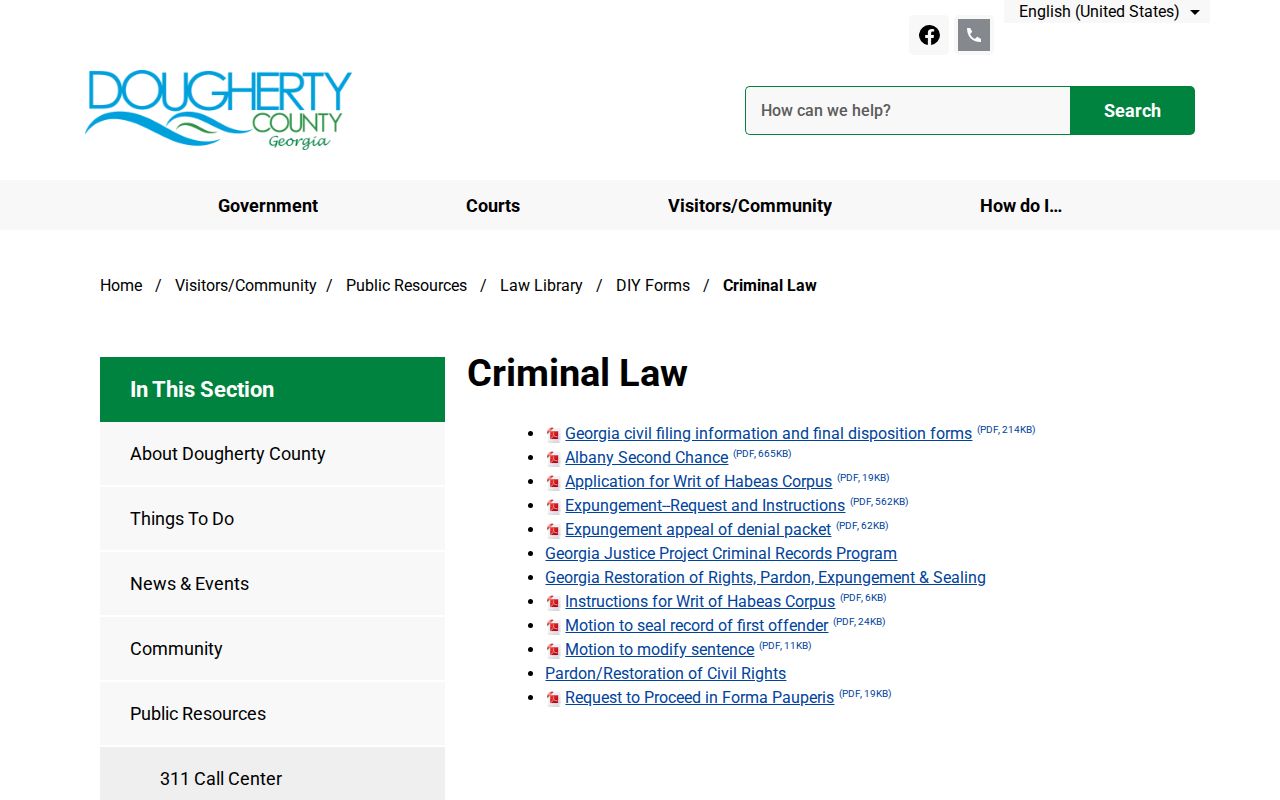
The Clerk, prosecutor, arresting agency, and GCIC may each hold a distinct part of the process.
Dougherty Jail History Connection
Section 19's facility-history angle explains why these locations must stay distinct. The old jail was designed for about 200 people. The county replaced it in 1995 with the larger Evelyn Avenue facility, which can hold up to 1,230. Housing moved to that jail while judicial and sheriff functions remain tied to Pine Avenue.
For release confirmation, this split creates a multi-record trail. The jail records the end of custody. Court-services staff process bonds and related transactions. The Clerk maintains the filed case history. Reading all three prevents a bond payment from being mistaken for case completion or a jail departure from being mistaken for unrestricted community release.
The physical split explains why one call may not settle every bond release question. Custody staff, bond processors, and court clerks maintain different parts of the same event.