
Dougherty Released Mugshot Records
A mugshot is the photograph made during booking. It documents arrest intake, not guilt or a final court result. Once someone leaves the Dougherty County Jail Facility, the person may drop from a current-inmate view while the booking photo remains with the Sheriff's Office. Georgia law also limits some disclosures. O.C.G.A. Section 35-1-19 restricts release when a requester may publish the photo and charge for removal.
A neutral request for personal correction, release verification, or court process should identify the exact booking and ask if the image is releasable. The court docket may show the outcome but not the photo. This distinction prevents a booking image from being mistaken for proof that a case ended in conviction.
Where Dougherty Released Mugshots Appear
The right source depends on custody type and booking age. No separate Dougherty release-photo feed was found.
| Channel | Photo? | Access |
|---|---|---|
| Dougherty P2C | When enabled | Search the inmate catalog. |
| Sheriff records | If releasable | Request the named booking. |
| GDC search | When available | Use for state custody. |
| GBI registry | For registrants | Use only for registry status. |
| News | Sometimes | Treat as context. |
Compare name, age, agency, charge, and date. A GDC image is not necessarily the Dougherty jail image. A registry photo documents a separate legal duty and does not prove a release date.
Dougherty P2C Mugshot Search
The Dougherty P2C inmate catalog is the confirmed Sheriff's lookup. Its module supports image IDs plus arrest, charge, bond, court, facility, and release fields. Search the full name, open the booking, and record the identifying fields. If the person has vanished, use the Dougherty release fallback or request the image. Retention is not published.
A separate P2C sex-offender module exists. Research found local reporting about a registry app, but no Sheriff mobile app with a rolling feed of released-inmate mugshots. Registry confirmation applies only to registered people. It is not a general booking-photo archive.
Request Dougherty Booking Photos
Call Criminal Records at 229-430-6516. Jail Intake is 229-430-6531. Georgia's Open Records Act generally requires an initial response within three business days, though production may take longer or an exemption may apply.
- Give the full name and booking date.
- Name the Dougherty County Jail Facility.
- Add birth date, case, docket, or charge details.
- Ask for the photo tied to that booking.
- Ask if it is releasable and what copy fee applies.
- Seek court dispositions from the Clerk.
Paper copies may cost $0.10 per page plus lawful search and redaction costs. A special photo restriction can still control the image itself.
Dougherty Mugshots Outside Government
WALB and the Albany Herald have covered Dougherty jail policy and registry issues. News images supply journalistic context, not an official photo repository. Commercial aggregators may retain stale charges, dates, or images and may omit restriction or correction. No commercial mugshot publisher is linked here. Start with the Sheriff, GDC, GBI, or Clerk.
The GBI registry page explains the limited registry channel.
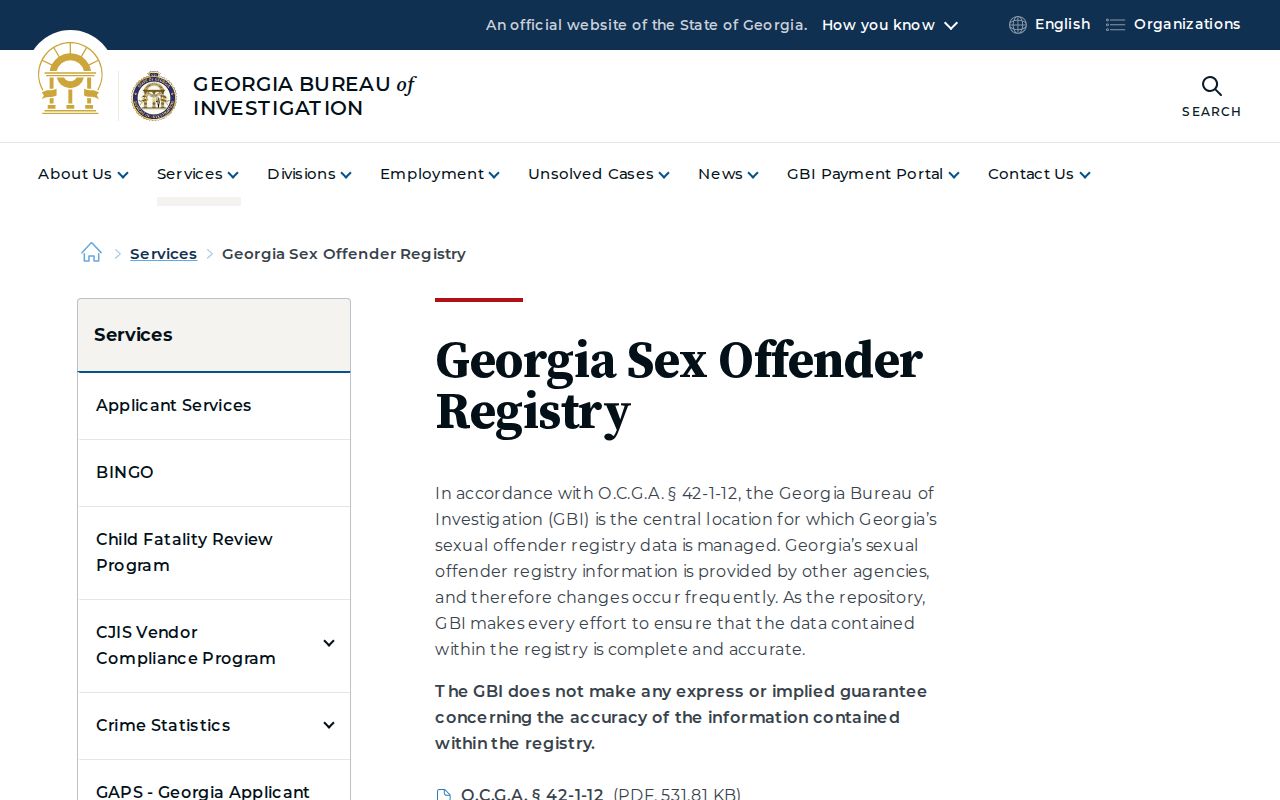
The state page shows why registry photos cannot stand in for a general release-photo search.
Restrict Dougherty Mugshot Records
Georgia usually calls expungement “record restriction.” Dougherty's Criminal Law page links instructions, an appeal packet, and restoration and sealing materials. O.C.G.A. Section 35-3-37 governs restriction, and the local path may involve the arresting agency or prosecutor. Restriction changes access but does not mean each copy vanishes at once.
The Georgia Attorney General explains that qualifying commercial mugshots must be removed without charge within 30 days after a written request in eight circumstances.
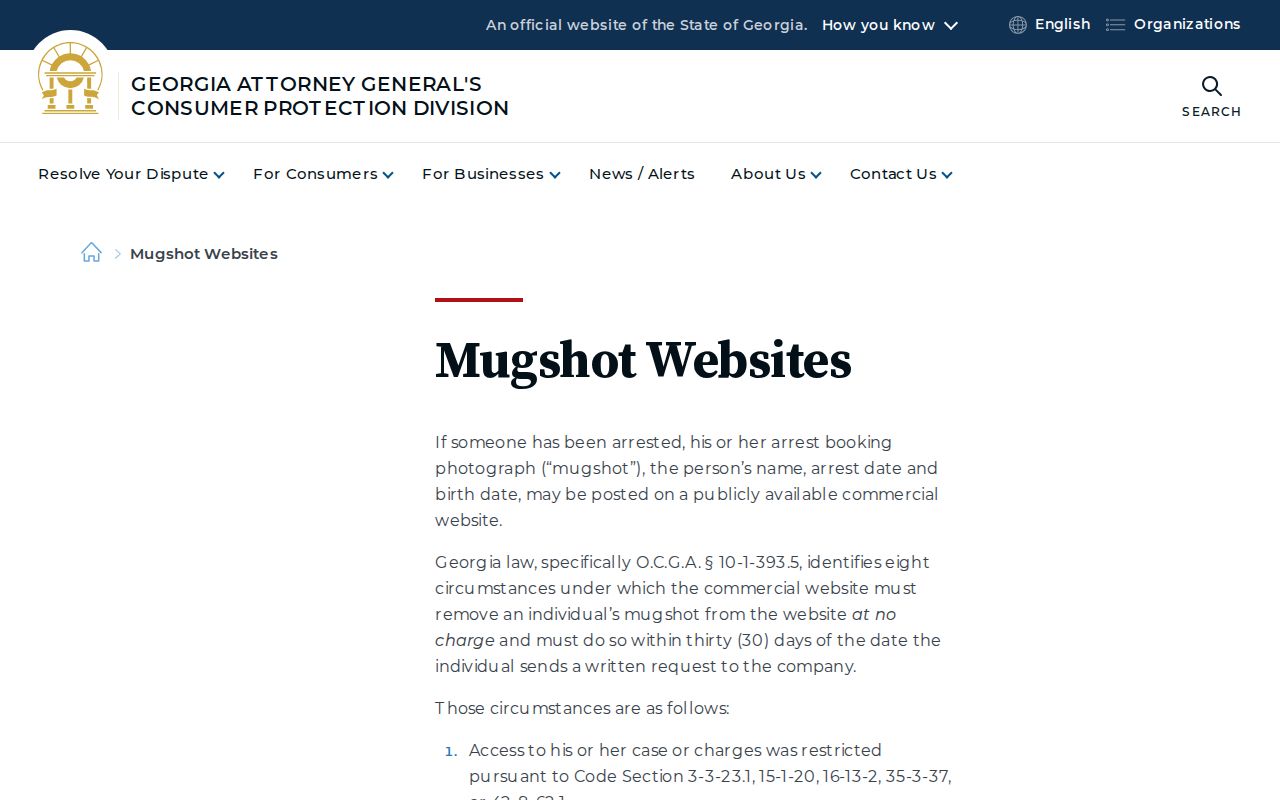
This rule addresses commercial copies. It is separate from a Sheriff's request and from court or criminal-history restriction.
Dougherty Release Photos and Apps
Dougherty County's confirmed Sheriff tool is Police-to-Citizen. P2C separates the inmate catalog from its sex-offender module. That division matters. An inmate result can carry a booking image when the county enables public photos, while the sex-offender module serves only people who have a registration duty under Georgia law. Neither research nor the official source sweep confirmed a Sheriff mobile app that publishes a rolling gallery of Dougherty County released mugshots.
WALB reported in 2024 that residents could check local sex-offender registry information through a county app or the Sheriff's Office. That narrow app function must not be expanded into a claim about all jail releases. A registered person's profile photo may help identify the correct registry entry, but it does not supply the booking release reason, prove the date custody ended, or show that every listed person was released from the Dougherty County Jail Facility.
For an ordinary jail booking, start with P2C and then Criminal Records. For a state-prison image, use GDC. Use the GBI or Dougherty registry only when registration status is the fact being checked. This source-by-source approach keeps a current registry photo from being mislabeled as a Dougherty County jail mugshot.
Dougherty Mugshot Restriction Resources
Dougherty County has a more useful local restriction path than a generic statewide summary. The county Law Library's Criminal Law page collects expungement and restriction instructions, an appeal packet, Georgia Justice Project criminal-record resources, and materials on restoration, pardons, and sealing. Those documents help a person identify which office and process fits the record. Georgia.gov adds that a county request may require contact with the arresting agency or the prosecuting attorney.
Restriction is not the same as correcting a false match. If the wrong image appears on a booking, preserve the URL, booking number, and visible identifiers, then contact the office that supplied the record. If the image is accurate but tied to a case eligible for restriction, follow the statutory process under O.C.G.A. Section 35-3-37. A commercial site's removal duty under O.C.G.A. Section 10-1-393.5 is a third, separate route.
These distinctions prevent a common mistake. An approved restriction can limit public access to qualifying criminal-history information, but it does not rewrite the court result or guarantee that every news archive changes at once. The official order and the originating agencies control the public-record response. Keep copies of requests, orders, and agency replies so the same Dougherty County booking can be identified across systems.
Dougherty Release News Photo Limits
Local reporting supplies useful history but is a poor tool for verifying one released person. WALB covered Dougherty County's 2020 early-release review and the sharp jail-population reduction during the first COVID response. The Albany Herald later reported on continuing benefits attributed to those release policies. Those stories explain why local release practices drew public attention. They do not operate as current inmate catalogs, and an image published with a policy story may be a facility photo rather than a person's booking image.
Dates matter as well. A news photo can remain online years after the custody event, even when the Sheriff no longer displays the booking card. Captions may summarize the charge known on publication day without reflecting a later dismissal, plea, restriction, or sentence. Confirm a Dougherty County release through the Sheriff's release record and the Clerk's docket, not through the date of an article.
When a report contains a person's photo, trace it to the credited source. If the credit points to the Sheriff's Office or GDC, request the matching official record. If the image is editorial or unrelated file art, it cannot establish identity. Local news is best used for policy context, while P2C, Criminal Records, GDC, GBI, and the courts supply the record-specific trail.
Match Dougherty Mugshots to Releases
A photo becomes useful only after it is matched to the correct release record. When a P2C booking remains visible, capture the full name, arrest date, court date, booking agency, holding facility, primary charge, docket number, bond type, bond status, and any displayed release date or reason. The underlying P2C module can support those fields, but the county's public settings may show only part of them. A card with a photo and a name is not enough to distinguish two similar people.
Next, classify the custody outcome. Bond means the person left jail while the case could remain open. Time served or sentence complete describes a different path. Transfer to GDC, another county, federal custody, or an immigration hold is not release into the community. For a bond or court-ordered event, compare the booking with the Dougherty County Clerk case search. For a state transfer, match the person through GDC using the GDC ID, physical details, case number, and county of conviction.
If no public image remains, request the booking sheet and photograph together. That pairing gives Criminal Records enough detail to locate the right intake event and lets the requester compare the photo with the release date, release reason, charges, and booking number. It also creates a clearer correction path if an image or identity was attached to the wrong record.
Keep the source date with any saved copy. A photograph may remain accurate as an image while the text around it becomes stale. Later court action can change charge status, bond terms, sentence information, or public access. Recheck the Clerk's record when precision matters, and ask the Sheriff's Office for clarification when the public P2C card omits a release field. This final comparison turns a loose image into a traceable Dougherty County record.