
Dougherty Projected and Actual Dates
A projected date is an estimate or scheduled point based on the sentence and information known at that time. An actual release date records what occurred. Those dates may match, but they answer different questions. The public Dougherty Police-to-Citizen system can support expected-release and released labels. An expected date does not show that the person left the jail.
Pretrial custody is less predictable. A detainee may leave after bond is processed, after a judge enters an order, or after another agency lifts a hold. The person may instead transfer to GDC, another county, federal custody, or immigration custody. A transfer ends the Dougherty jail stay but is not freedom in the community.
Find a Dougherty Projected Release
The correct source follows the last holding agency. The Dougherty County Jail Facility is a county jail, even though GDC lists it as a county location. Its dates come from jail and court records. A person committed to a Georgia prison belongs in GDC and parole systems. The Dougherty County released inmate search gives the full custody-to-record path when the holding system is unclear.
- Search the official Dougherty P2C inmate catalog. Note custody, booking, court, bond, and any expected-release field still displayed.
- For a local sentence or pretrial case, call Jail Intake at 229-430-6531 or Criminal Records at 229-430-6516 and check the court docket.
- For state custody, use the GDC offender query with name, ID, or case data.
- For parole consideration, use PAP's TPM lookup. Treat a Tentative Parole Month as tentative.
- If public data is insufficient, request the relevant jail, court, or GDC record in writing.
- On the anticipated day, confirm actual release or transfer with the agency that held the person.
GDC describes its search as a tool for people currently serving in GDC facilities. Released-person accuracy may require written verification from Inmate Records and Information at PO Box 1529, Forsyth, GA 31029. County jail offenders should be searched through the county source first.
Dougherty County Earned-Time Rules
Georgia Code Section 42-4-7 governs county inmate records and earned-time allowances. It says the sheriff or jail keeper maintains records of county inmates and that earned time is based on institutional behavior. For modern covered county sentences, the allowance is not automatic or mandatory. A county inmate is released when the sentence expires less earned time properly deducted.
Dougherty County's handbook makes the local consequence concrete. Disciplinary sanctions can take away good-time credit. Some sanctions may remove up to one-half of it, while major violations may lead to loss of all such credit. Therefore, a date computed early in a county sentence can move later if credit is lost. Jail staff and the sentence record, not a rough calendar count, control the official calculation.
Not every sentence can be shortened in the same way. O.C.G.A. Section 17-10-6.1 imposes mandatory terms and restrictions for listed serious violent felonies. Those mandatory portions cannot be reduced by parole, earned time, early release, work release, leave, or similar measures. The offense, sentence, and governing statute must be checked before assuming good time applies.
Why Dougherty Release Dates Change
A projected date changes when a fact behind the calculation changes. Some events move the date. Others change where the person goes without changing the end of the local booking. A detainer, for example, may cause an immediate transfer to another authority rather than community release.
| Factor | Effect on the date or release | Best source |
|---|---|---|
| Earned-time gain | May reduce a qualifying county sentence | Jail sentence record |
| Discipline | Loss of credit may move the date later | Dougherty jail record |
| Bond or court order | May end pretrial custody before any sentence date | Court docket and Booking, Bonds and Fines |
| Detainer or hold | May result in transfer instead of community release | Jail and receiving agency |
| Parole decision | A TPM may be set, changed, postponed, or denied | PAP lookup and records |
| Sentence restriction | Mandatory terms can bar sentence-reducing credits | Judgment and Georgia law |
A release reason matters as much as the date. “Transfer to GDC” points to continuing state custody. “Bond” means the case remains pending. “Sentence complete” differs from parole, because parole begins supervised release before the full sentence expires.
Confirm Dougherty Actual Release
On or after the expected date, check the source again. A person who vanishes from the current P2C catalog may have been released, but may also have transferred. Ask Jail Intake or Criminal Records for the release date, time, reason, and receiving agency. If bond or a court order drove the event, reconcile it with the Dougherty Clerk's civil and criminal case search.
Georgia VINE can send custody notifications from participating feeds. The VINELink Release Check explains registration and the limits of those alerts. VINE is not certified proof and can lag an agency update. For GDC cases, confirm the offender record and contact Inmate Records when precision matters. For federal or immigration custody, use BOP or ICE rather than county systems.
Note: A current roster answers who is held now; a release record explains what ended that custody event.
Dougherty Tentative Parole Months
A Tentative Parole Month, or TPM, applies to eligible GDC inmates under Board review. The PAP lookup accepts a six-digit inmate number, a GDC ID, or personal data. The result can show a month when one has been set. It is not a promise of release and does not apply to a typical pretrial detainee in the Dougherty County Jail.
Georgia parole eligibility under O.C.G.A. Section 42-9-45 permits consideration at defined points, subject to exceptions. Eligibility does not force a grant. The Board may deny parole, set a TPM, or revisit a tentative decision. Misconduct or an unmet precondition can postpone or cancel release. For certain life cases, the Board uses a grant-or-deny decision rather than the standard guidelines result.
The official Board explanation is shown in the matching manifest image.
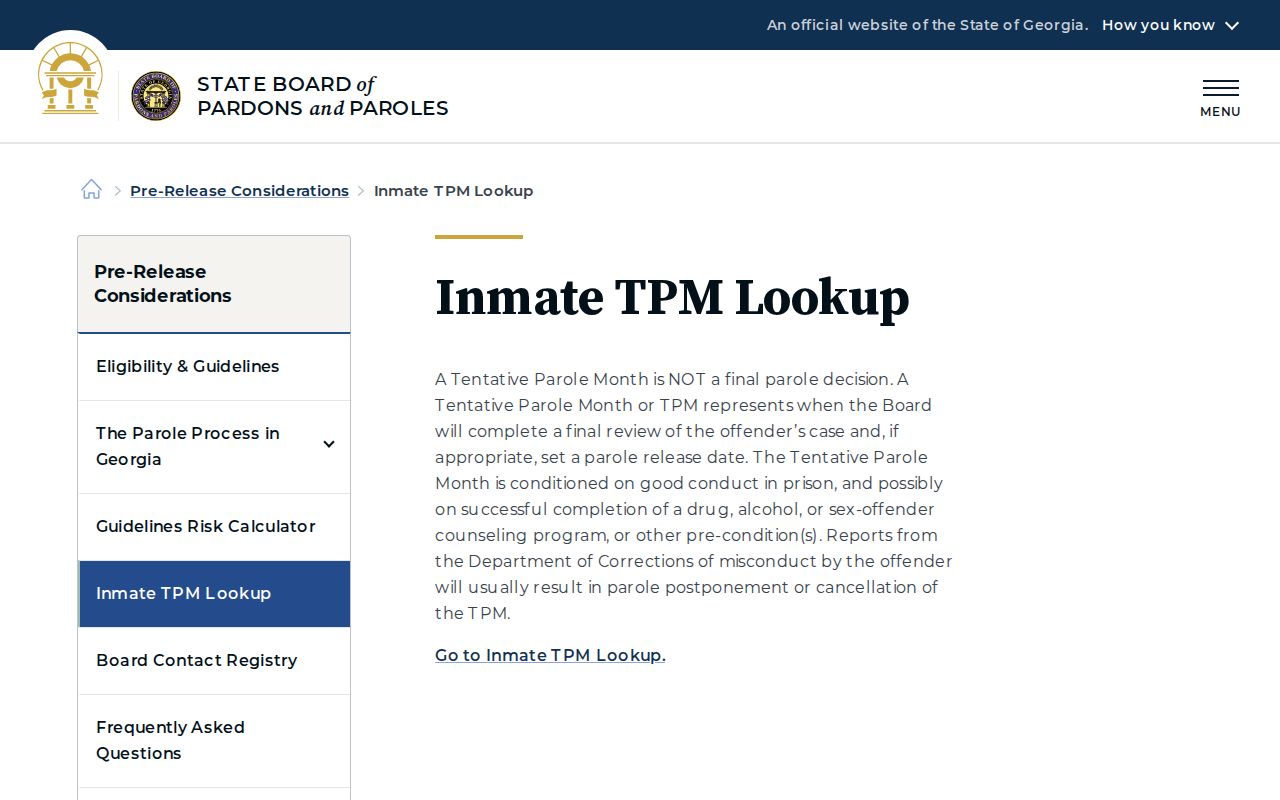
The page stresses the tentative nature of the month, which is why it must not be presented as an actual release date.
Dougherty State Sentence Credits
GDC's Performance Incentive Credit program is a state-prison tool, not the county earned-time rule. PIC can reduce length of stay for eligible offenders who complete case-plan goals and maintain positive behavior. Its impact depends on eligibility and agency records. A family should not apply a general percentage to a sentence.
The official PIC source below matches this state sentence topic.
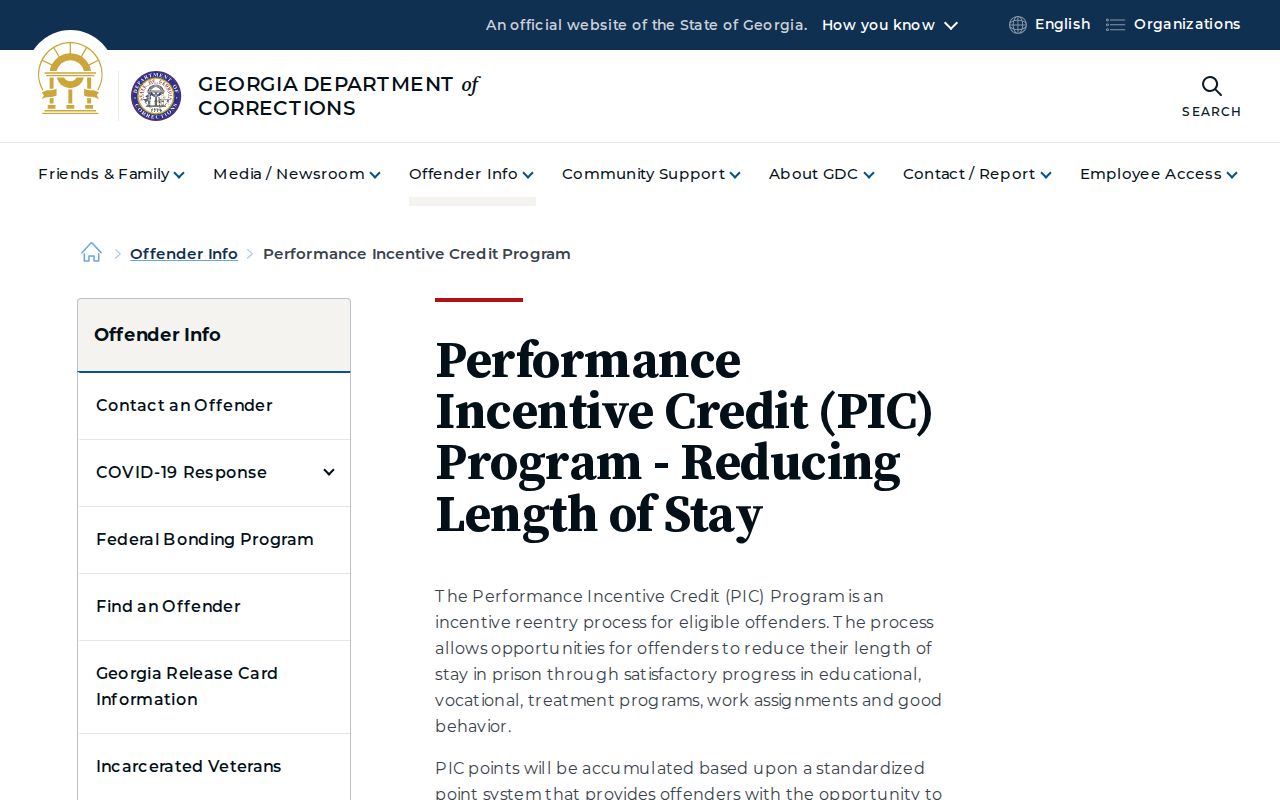
County earned time, GDC PIC, and parole are three separate mechanisms. The Dougherty jail applies the county framework, GDC administers prison credits, and PAP controls parole decisions.
Dougherty Date Record Requests
When a public screen does not settle the date, request the record held by the right agency. Dougherty Criminal Records can be reached at 229-430-6516, while the jail's main line is 229-430-6500. A local request should identify the person, booking or inmate number if known, approximate custody dates, and the precise fields sought, such as release date, time, reason, and transfer destination.
GDC uses its open-records portal and reports an initial response within three business days. Non-medical copies are listed at ten cents per page, with search and redaction time billed at the rate of the lowest qualified employee. A request is often the better route when an online state result lacks historic detail.
The official GDC request page appears in the matching image.
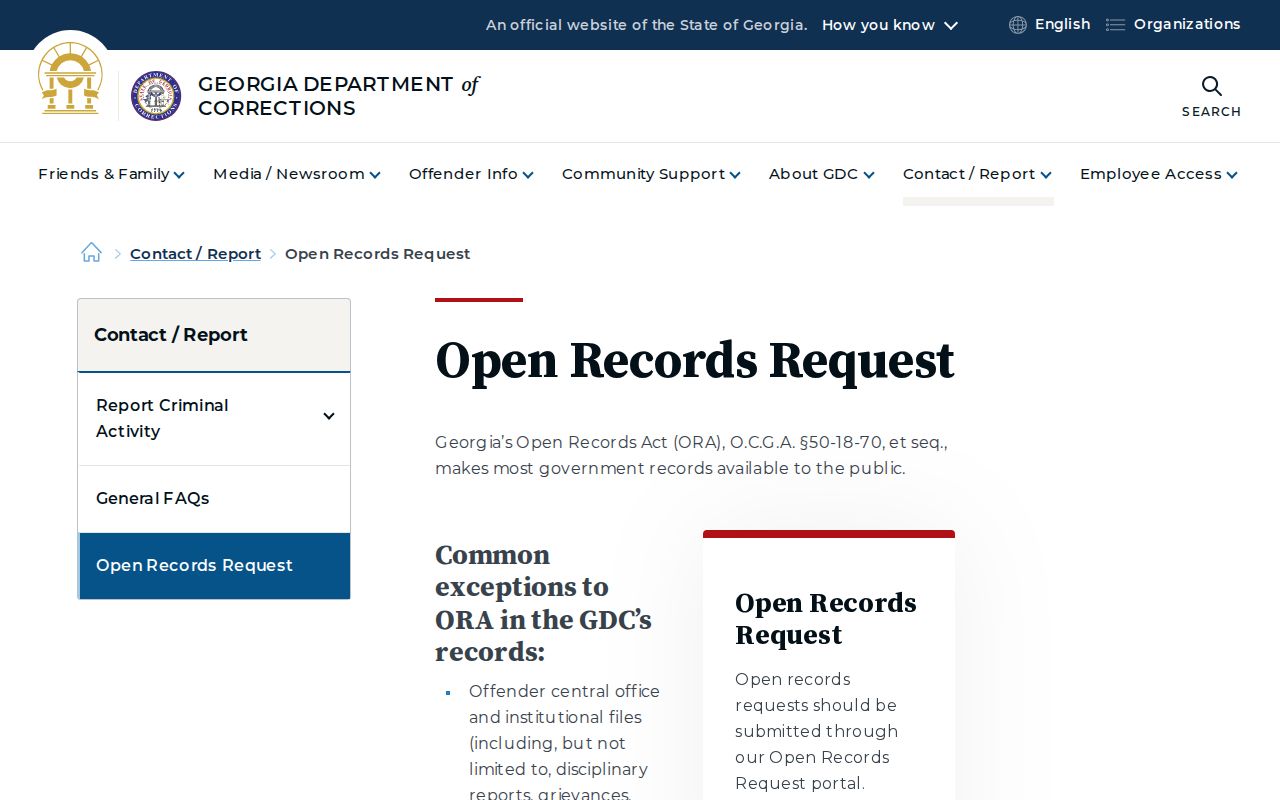
That state portal should be used for GDC records, while Dougherty County remains the source for its jail and local release records.
Dougherty Court Date Checks
The court record may be essential for a local release date. A bond order, sentence, probation order, dismissal, or revocation can explain why the jail calculation changed. The Dougherty Clerk's party search covers public State and Superior Court case data. If the portal is hard to use, the Clerk lists 229-431-2198 and weekday business hours from 8:30 a.m. to 5:00 p.m. A caller should ask for help locating the filed order rather than asking court staff to calculate a jail date.
A docket date is not always a custody date. A hearing can be continued while the person stays in jail, and a sentence can be entered before staff complete release processing. Bond can also leave a case pending after the person exits custody. Compare the order with the jail's release date, time, and reason. When another hold exists, the same order may end the Dougherty case without producing community release.
For a state sentence, keep the judgment with the GDC response and any PAP result. Those records show different stages. The judgment states the sentence, GDC administers custody and eligible credits, and PAP controls parole decisions. This chain is more reliable than treating one projected field as final.